Sunday, October 20, 2013

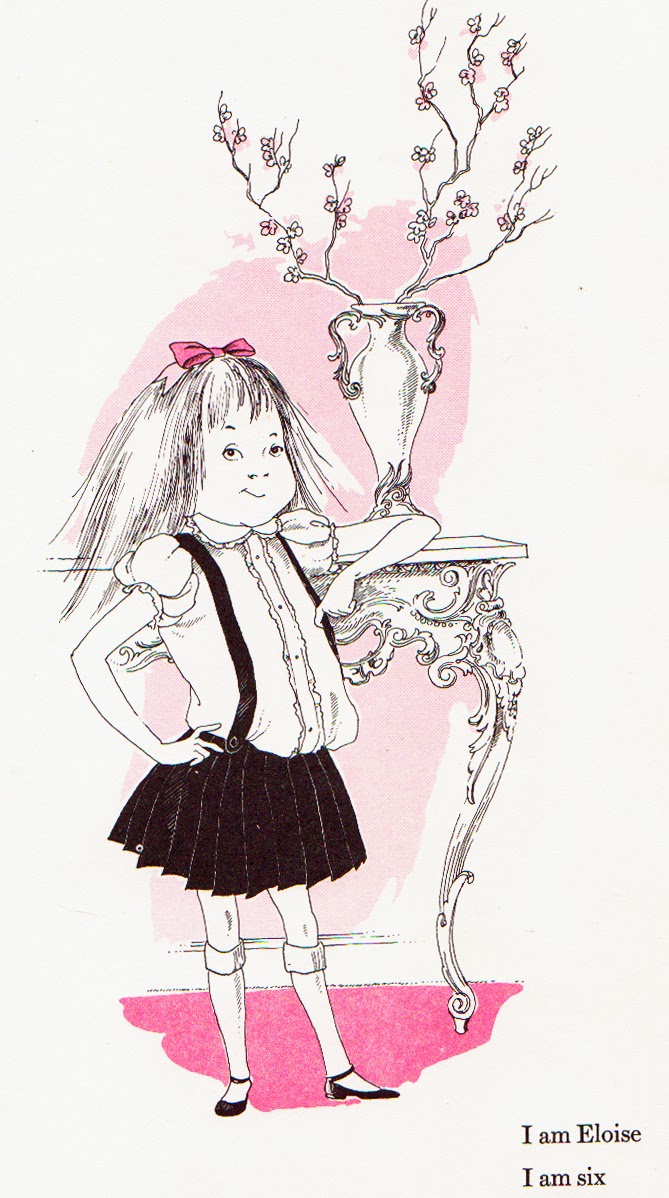
Eloise Redux

Kay Thompson ~ Hilary Knight ~ Simon and Schuster, 1969

Forgive me as I've posted on this book before, and it's hardly an undiscovered treasure, but I felt like now was the appropriate time in my son's book reading career to fully appreciate Eloise. When I posted on it back in 2008, my son was a toddler, and though he loved Eloise dearly, I don't remember that he did it with the same amount of vigor and understanding that he embraces her with now.

"Kleenex makes a very good hat"


Often people ask me what my favorite children's book is and I compile lists in my head or tell people the favorites that I think will most match their tastes. But, unequivocally, if someone were to ask me what my all-time favorite children's book is and/or was, it will always, always, ALWAYS be, forever and always until the end of time... Eloise.


The copy we have in our collection now, it not my true childhood copy. My two sisters and I read our original copy so vigorously in our little kid years that by the time I got to elementary school it had long since fallen apart and been lost. Later, when I was around ten years old, my mother took me to the local bookshop and told me I could get anything I wanted. Instead of buying one of the Narnia books, The Wizard of Oz or a Cynthia Voight title, I opted for an upgrade of Eloise. So many of the books in our family library were hand-me-downs from my sisters or shared books, that I remember being so enamored with having a brand new Eloise that was all my own. This copy followed me through high school, to my dorm room at college and to my first apartment in Williamsburg, Virginia, and my second apartment at 404 West 51st Street in New York...eventually finding its way to my son's bookshelf.

When I was young and my mother would take us on trips to New York, we would load in a cab and go on mecca to The Plaza for ONLY one reason. That is where Eloise lived.

I could spend hours looking at that book, even in high school, getting lost in the illustrations, chuckling over the hidden treasures tucked within each. It is an absooooolutely PERFECT book, from beginning to end in both words and pictures. I could go on and on about images and moments I love in this book. The foldout elevator sequence where Eloise movements in the text are mapped out exactly in a dotted arrow line.


How all of her imaginary scenarios are inked out in a red (pink?), sometimes so faint, it almost seems like they are not there at all.


Weenie (the dog that looks like a cat), Skipperdee (the turtle that loves strawberry leaves), and Nanny (the beer loving boxing fan)! Each and every character, a dream.


My son always loved it as a wee one, but for several years it has sat untouched on the back of his bookshelf (that, BTW, is so overloaded, each shelf is two or three books deep, and once things get lost in the back row, they are often never heard from again.) A few weeks ago, it managed to squirt itself back up to the front row, and I read it to him at bedtime, and the giggling commenced. And when I say giggling, I really mean chortling, belly laughing, screaming and screeching hysterically. So for the past few weeks, it feels like Eloise makes her way to the top of the read pile each and every night. My husband is now convinced that Eloise is psychotic... as evidenced by the pictures below, and whenever he states this fact aloud, it just makes my son howl all the more. (The gin, the nailing of the chair to the floor, the sawing of the doll in half, the bizarre role playing... literally, I could go on and on.) My son thinks the fact everything Eloise owns is wrecked is outrageously awesome.


I have come to the conclusion that Kay Thompson, Hillary Knight and my son are cut from the same cloth, and, in fact, share the exact same sense of humor. He finds the oddest lines to be so massively funny that he has trouble breathing at least five times in a read through.

My son's favorite passage?

While I'm brushing my teeth there is this pigeon 
who is always hanging around our bathroom window 
and he does absolutely nothing but coo
He is fat and grisly and I holler at him 

It slays him each and every time. Go figure.


This book. Always, always, always and forever in my heart.


Also by:
The Hungry Thing
The Cat Who Wore a Pot on Her Head

--------------------------------------------------

Read along on Facebook, tumblr, Twitter and Etsy.

Sunday, October 6, 2013

The Silly Listening Book

Jan Slepian and Ann Seidler ~ Richard E. Martin ~ Follett, 1967

I still can't resist a book by the Slepian-Seidler-Martin trio, as wild and wonderful as they are. This one is perfect for the toddler set as it is filled with odd pairings and silly sounds.

Where is your ear?
Can it hear...
Quiet sounds...shhhh?
Loud sounds....BOOM!
Wet sounds...splash?
Even sounds that are silly like hum-a-dum-dilly?


It continues on page after page. Does it hear a mouse's tear? A dog playing cowboy. A bird who found a chocolate worm. Can you hear...A lollipop cry? The laugh of a fly? A pie say goodbye?


All aptly illustrated with Martin's always mildly whack-a-doodle drawings and culminating in a party for everyone. By the way, any book that features a dog playing cowboy is OK in my book. Brilliant!


Also by:
The Hungry Thing
The Cat Who Wore a Pot on Her Head

--------------------------------------------------

Read along on Facebook, tumblr, Twitter and Etsy.

Monday, September 30, 2013

The World Is Round - Re-released!

I just got an e-mail today from HarperCollins letting me know that a facsimile edition of Gertrude Stein’s only children’s book, The World is Round, is due out in October. If you've never read Ariel Winter's write up on it on his blog We Too Were Children, you are in for a treat! He includes wonderful photos of the original limited edition released at publication. Just fabulous! 

Anyways, illustrated by Clement Hurd, the beloved illustrator of Goodnight Moon and The Runaway Bunny, this edition is being released to coincide with the 75th anniversary of its publication.  

From the publisher:

Written in Stein’s unique prose style, The World is Round tells the story of a young girl named Rose, who contemplates who, what, and, why she is, often expressing herself through rhyme and song. Although published as a children’s story, the book is a literary work for adults, too, as Stein focuses on themes of individualism and personal identity. As with many of her writings, Stein plays with words and language throughout the book, incorporating her most famous line, “Rose is a rose is a rose is a rose,” several times in the story.

The book also features:
  •  a foreword by Clement Hurd’s son
  • numerous correspondence between Stein and Hurd during their collaboration on this work
  • an essay by Edith Thacher Hurd, Clement Hurd’s wife, entitled “The World Is Not Flat,” which tells the behind-the-scenes story of the making of the book

I, for one, can NOT Wait!
__________________________

Read along on Facebook, tumblr, Twitter and Etsy.

Wednesday, September 25, 2013

Guest Post: The Lonely Doll Learns a Lesson

Back for one final post, again, help me in welcoming my good friend, fellow old book collector, and Etsy purveyor of all things vintage modern and awesome, Thingummery.


Dare Wright, Random House, 1961

It’s pretty hard to talk about Dare Wright’s Lonely Doll series without talking about Dare Wright. This isn't generally the case with children’s book authors. Though I’m always curious to read biographies of my favorites, I don’t actually need to know about the personal life of William Stieg or Margaret Wise Brown to appreciate their work. Dare Wright is a different story, because her stories—about a pretty, narcissistic doll and her surrogate family of Steiff stuffies—are so oddly beautiful, so unsettling and also share an uncanny resemblance to Wright’s own deeply unsettling, very sad life.

You can read the 2004 biography The Secret Life of the Lonely Doll by Jean Nathan for all the chilling details; I read the excerpt in Vanity Fair and then immediately bought the book, but I've never read the whole thing. It’s just too sad. The nutshell is that in 1917, Dare’s parents divorced when she was just three. Her father, a theater critic, moved from their home in Cleveland to NYC with her beloved older brother, leaving Dare alone to contend with her overbearing mother Edith, a society portrait painter. Oh, and Edith just happens to be the name of the titular Lonely Doll, who just happens to look exactly like Dare.

According to the biography, the mother-daughter relationship was very intense, very strange, and much has been made of the fact that as adults they shared the same bed and that Dare never married and quite possibly remained a virgin her whole life. It’s all very Grey Gardens/What Ever Happened to Baby Jane type stuff. After Dare finished high school, they moved to NYC, where she struggled as an actress, succeeded as a high fashion model, but ultimately preferred to work behind the camera, as a fashion photographer and then as the author/creator of the books that would become her life’s work. Today, those books enjoy an illustrious cult following: A New York Times article from a few years ago name-checks all sorts of literary/fashion/music icons who admire her, including Kim Gordon, Anna Sui, Steve Meisel and David LaChapelle.

There are ten books in the Lonely Doll series, three of which were reissued in the late 1990s by Houghton Mifflin (including the first) but I’m writing up The Lonely Doll Learns a Lesson because I scored the first edition at a library sale a few years ago. To sum up the first book, which was published in 1957 and introduces the characters—and the controversy surrounding them—Edith is a despairing doll living alone in a grand NYC mansion until one day two stuffed bears inexplicably arrive on the scene. Stern Mr. Bear becomes a father figure; his presumed son Little Bear becomes her brother and best friend. Like most kids, they get into all sorts of mischief. Single dad Mr. Bear grimly puts up with it until Edith one day plays dress-up with her never-seen, never-mentioned owner’s makeup and gowns without permission, so he puts her over his knee and spanks her bottom. He also threatens to abandon her, which is more distressing to Edith than the corporal punishment (hmm… father and brother abandoning little girl… sounds familiar, right?).

But it’s the spanking that disturbs (and/or titillates) a lot of readers, and it recurs in other books in the series. Which is why many adults find her stories too creepy to share with their kids, though I don’t think kids find them creepy at all (mine don’t). Adults see sadomasochistic subtext where kids only see an interesting anachronism—a misbehaving little girl getting spanked instead of being put in time out or having her iPad privileges revoked.

In The Lonely Doll Learns a Lesson, Edith doesn't get spanked for her bad behavior—she gets measles. The story begins with Edith enamored of a new kitten and Little Bear feeling very left out. Self-centered Edith is totally oblivious to her brother/BFF’s feelings until Mr. Bear has to give her one of his lectures. She agrees to make more of an effort to include Little Bear but they still keep bickering because Edith is so obsessed with the cat. Finally, Mr. Bear has to send her off to bed and then comfort poor Little Bear, who wishes he had a dog. 


The next morning Edith wakes up feeling crummy. The doctor is sent for and when it’s discovered she has measles, she has to stay in bed and find ways to pass the time (I love the photo where she’s reading Now We Are Six).


Little Bear pays her an illicit visit, right after the kitten has gotten all tangled in Edith’s hair. Little Bear decides to rectify matters by roughly cutting off Edith’s golden locks. She freaks out. Mr. Bear rushes to see what the fuss is about, and then does the only thing he can do—he finishes the job, giving Edith quite a cunning bob.

The next day, Edith is feeling better and regretful about her bad behavior. She goes to apologize to Little Bear and finds that now he has the measles too. She hatches a plan with Mr. Bear to buy him a puppy as a gesture of kindness and forgiveness, and all ends in happiness and harmony.


So are Dare Wright’s books compelling if you don’t know her backstory? I definitely think so. For one thing, her photographs are beautiful (especially if you have a taste for midcentury interiors and vintage New York City). But her most impressive artistic achievement is creating a hermetically sealed world inhabited by a doll and two bears. A world that’s convincing the way a really good episode of The Twilight Zone is convincing: something doesn't feel quite right but you don’t find out what it is until the end. With the Lonely Doll books, you don’t ever have to find out—unless you choose to read about Dare’s real life.


__________________________

Read along on Facebook, tumblr, Twitter and Etsy.

Tuesday, September 24, 2013

Atomics for the Millions and Peter Sieruta


Atomics for the Millions
Dr. Maxwell Leigh Eidinoff - Hyman Ruchlis - Maurice Sendak - McGraw-Hill, 1947

Recently, I've been thinking about Peter Sieruta. I was cleaning up my side bar the other day and saw his site listed in my blog roll and nostalgically took a click. 

Peter and I both started blogging about children's books in 2007, just a few months apart, and back then, he was one of only a few on the landscape. Reading his blog always made me feel smart, or rather always made me feel like my blog was authored by an airhead, but by reading his blog, Collecting Children's Books, it would make me smarter. I was a dabbler, but he... HE was someone who really knew what he was talking about. He was a writer for Horn Book, and his opinion was respected and his knowledge about the subject of children's books, bottomless. He was the real thing. He was in the middle of writing a book with Seven Impossible Things and Fuse Eight. His posts were knowledgeable and heartfelt, and often made me cry with their generosity of spirit about seemingly little things that mattered a whole lot.

Peter died tragically and unexpectedly over a year ago. His dear little blog sits untouched since May 13, 2012. I'm not much of a social butterfly when it comes to the internet, and in all those years, I never reached out to him beyond a few random comments on posts I loved. If I could talk to him now, I would tell him how I always respected him from afar. I would tell him what a great writer he is. How I wished I knew as much as he did about everything. 

As I started sorting through his blog pages again, I came across a post he did on the first book Maurice Sendak illustrated, Atomics for the Millions, illustrated when Maurice was only 19 as a favor to one of his teachers. The next day I checked the shelves at my office, and of course, it was there. Pulling it from the shelf felt precious and wonderful. The weight of it in my hand. The way the cloth cover felt on my fingertips. The cracking spine and pencil-made notes in the margins left by students long ago. I stood marveling at the illustrations, such a wonder, looking back on this early hint of a life so well-illustrated. Smiling at the connection I felt, like so many others, with Maurice Sendak because of the books he illustrated that I've loved. Smiling about how this little moment among the stacks was brought about by a stranger who always seemed like a dear friend because of the love of books we shared. 

I was thinking of cleaning Collecting Children's Books off my side bar, but only for a second, then thought better of it. I'll probably keep returning to it as there is always something new to discover. If you've never read Peter's blog before, start here and enjoy. If you discover a wonder or two there, something that reminds or delights, remember that it is readers like Peter who truly make books come alive. Through his love for children's literature, Peter took the best of the boy and translated it into one hell of man. It we could all keep the best of childhood alive in our hearts like that, the world would be a better place indeed.


Read along on Facebook, tumblr, Twitter and Etsy.

Guest Post: The Sorcerer’s Apprentice

Again, help me in welcoming my good friend, fellow old book collector, and Etsy purveyor of all things vintage modern and awesome, Thingummery as she explores a book illustrated by the magnificent Ungerer and written by the author of the Scarry-illustrated Golden classic Rudolph the Red-Nosed Reindeer. Fabulous!


The Sorcerer's Apprentice
Barbara Hazen ~ Tomi Ungerer ~ Lancelot Press, 1969

It’s a wonderful thing to go to an estate sale and find a Tomi Ungerer book you didn't even know existed, especially one illustrated at what might be considered the apex of his children’s book illustrating career. The Sorcerer’s Apprentice was published in 1969, around the same time period as some of my favorites: Moon Man, Zarelda’s Ogre, The Hat, The Beast of Monsieur Racine… But unlike those masterworks, Ungerer didn't write The Sorcerer’s Apprentice; he left that to Barbara Hazen, better known as Barbara Shook Hazen, a midcentury magazine editor turned prolific children’s book author, who has over 80 titles to her credit. Of those many titles, I’m only familiar with two: The Knight Who Was Afraid of the Dark, an old favorite at my house, and Mr. Ed, The Talking Horse (yes, that Mr. Ed, and if you’re interested, I've got a copy for sale at my etsy shop).


No offense to Ms. Hazen (who I believe is still living and working in NYC), but this book is really about the pictures, which should come as no surprise to Ungerer fans. Based on a poem by Goethe—though best known in its Mickey Mouse incarnation—Hazen’s version of the tale of a ne’er-do-well apprentice who unleashes powers he cannot possibly control is a bit overworked and wordy for my taste (my kids think I’m being a snob). Probably anyone’s prose would seem colorless next to these illustrations, which are classic Ungerer: trippy, witty and always with a deep, dark underbelly. Full of cockeyed references to previous books, disembodied body parts and loopy creatures. Kind of like Highlights magazine’s “Hidden Pictures” reimagined by a very sinister mind. The broom alone is terrifying.


The story line doesn't waver much from the classic telling of the tale. We meet a “wise old wizard” who lived in a castle “high above the River Rhine.”

The cellar was the sorcerer’s workshop. One side of the cellar was lined with shelves of musty, dusty, leather-bound books. By far the most important book of all was an enormous volume called Complete Magic Spells and Incantations... The book stood alone on the top shelf, where it was guarded day and night by an old green-eyed owl. The book was always locked, and the sorcerer always wore the key around his neck.


In the middle of the workshop was a water tub. Every day the tub had to be filled. Heavy buckets of water had to be brought all the way up the steep stone steps which led from the River Rhine.


Enter the Sorcerer’s Apprentice, the hapless Humboldt, whose task it is to tote those heavy buckets of water every day. Humboldt aspires to wizardhood, but he’s a total slacker so the sorcerer really has to ride him. “An apprentice must work. An apprentice must learn. An apprentice must earn his magic powers,” he chides, before heading off to a wizard conclave and leaving Humboldt to hold down the fort.


After the sorcerer disappears in his trademark puff of blue smoke, Humboldt kvetches:

“It isn't fair. He has all the fun and I do all the dirty work. Why should I slave all day when the master could cast one magic spell and have all the chores done in an instant. Magic’s a much easier way, and much more fun, too!”


When Humboldt discovers his master has forgotten to take the key to his big book of magic, he immediately opens it and finds the spell that will make a broom “fulfill all the wishes of your will.”


The foolish boy calls out the spell and all hell breaks loose. The guardian owl awakens and knocks him off the ladder.

The ladder crashed and broke in two. But luckily Humboldt landed unhurt, cushioned by the sorcerer’s stuffed crocodile. Humboldt lay there stunned. At first nothing happened. Had he said the wrong magic words?


But you know what happens next. The animated broom stirs, and gets right down to business, filling the sorcerer’s tub with water from the Rhine. And “Humboldt kept on singing and dancing and the broom kept on hobbling and bobbling, and the water kept on rising in the tub.”


Things really start to spiral out of control; the cellar begins to flood and Humboldt can’t undo the spell.

The water was now waist high. The cat was climbing the furniture and the snakes were slithering up the draperies. Scared and soaked to the skin, Humboldt knew he had to do something to stop the broom. He grabbed the sorcerer’s axe.


He cuts the broom in two, which only results in…more brooms. Way more creepy-faced brooms.


By now the flood had reached the top shelf of the bookcase. Humboldt was swimming for his life, and trying to catch the magic book, bobbing always just out of reach.


And just in the nick of time, in his trademark blue puff of smoke, the sorcerer appears and banishes the broom army with a spell. Humboldt feebly begs forgiveness, but the sorcerer just puts him to work, cleaning up the mess of his making. And in a twist I don’t recall from the Fantasia version of the tale, the broom briefly awakens to whack him on the butt four times, “sending the sorcerer’s apprentice flying all the way down the steep stone steps to the River Rhine. AND THAT WAS THAT!”
__________________________

Read along on Facebook, tumblr, Twitter and Etsy.

Related Posts Plugin for WordPress, Blogger...